The 50/30/20 Budget Rule (And Why It's a Starting Point, Not a Law)
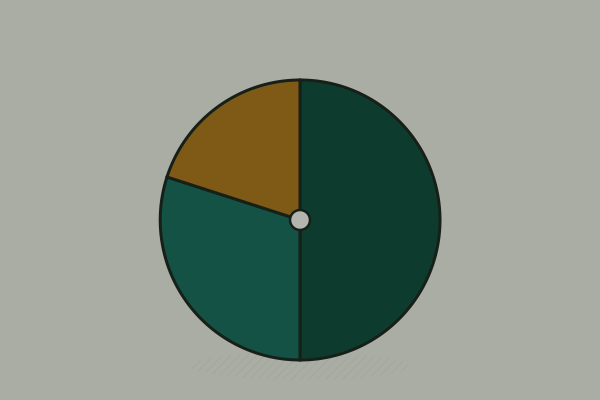
Every budgeting method I’ve seen eventually gets compared to the 50/30/20 rule, so I might as well explain what it actually is instead of assuming everyone already knows. It’s not the only way to budget, and it’s not right for everyone exactly as written — but it’s a genuinely useful starting point, which is more than most budgeting advice can claim.
The rule itself
Split your after-tax income into three buckets:
- 50% needs — rent/mortgage, utilities, groceries, minimum debt payments, insurance, transportation to work. Costs you can’t skip without a real consequence.
- 30% wants — dining out, entertainment, subscriptions, hobbies, upgrades. Costs that make life better but wouldn’t cause a crisis if cut.
- 20% savings and debt payoff — building an emergency fund, investing, and paying down debt beyond the minimum.
That’s the whole framework. Its appeal is that it’s simple enough to actually use — a budget you abandon after two weeks because it’s too granular to maintain isn’t better than a simple one you actually stick to.
Why “needs” is the category people get wrong
The honest version of “needs” is narrower than what most people initially file under it. A $60/month streaming bundle and a $18/month streaming bundle are both “entertainment,” not “needs,” even if one feels more essential day to day. The test worth applying: if you lost your income tomorrow, would you keep paying for this to avoid a real, immediate consequence? Rent passes that test. Most subscriptions don’t. Being honest about this category is most of what makes the framework actually work — inflating “needs” just quietly eats into the savings category without you noticing.
Where the exact percentages stop making sense
High cost-of-living areas. If rent alone eats 45-50% of your income before anything else, the 50% “needs” bucket is unrealistic on its face — this happens to plenty of people in expensive cities through no failure of budgeting. The fix isn’t guilt, it’s adjusting the ratios (maybe 60/20/20, or lower savings temporarily) while treating the reason you’re adjusting as a real constraint worth solving for, not a personal failing.
High-interest debt. If you’re carrying credit card debt at 20%+ interest, the “20% savings” category arguably belongs almost entirely to debt payoff rather than split with investing — paying off a 20% APR balance is a guaranteed 20% return that no investment reliably matches. The framework’s 20% bucket is a reasonable total to aim for; how you split it between debt and investing depends on what the debt is costing you.
Very low or very high income. At a low income, needs can reasonably eat well past 50% just to survive, and that’s not a budgeting error to fix with better spreadsheet discipline. At a high income, needs often shrink well under 50% in percentage terms even while the dollar amount grows — which is exactly the situation where pushing the savings percentage up past 20% (to 30-40%+) makes sense, since lifestyle “wants” spending has diminishing returns past a certain point anyway.
What to actually do with it
Treat 50/30/20 as a diagnostic, not a rulebook. Track your real spending for a month, sort it honestly into the three buckets (including the uncomfortable reclassifications above), and see where you actually land versus the target. The gap between where you are and 50/30/20 tells you something useful even if you never hit the exact numbers — a “needs” bucket at 70% tells you something structural is worth addressing (income, location, fixed costs); a “wants” bucket that’s ballooned to 45% while savings sits near zero tells you something different, and more directly fixable.
The takeaway
50/30/20 isn’t a law of personal finance, it’s a reasonable default that’s easy enough to remember and use as a gut check. If your numbers don’t match it, that’s information, not a verdict — the goal is understanding where your money actually goes and making a deliberate choice about it, not hitting three specific digits.
Discussion