FSA vs. HSA: They're Not the Same Account, and Mixing Them Up Costs Money
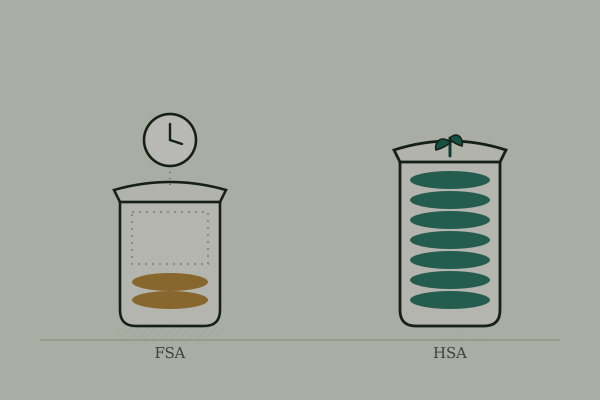
I explained the HSA’s triple tax break without ever mentioning the account most people actually confuse it with: the FSA. They sound similar, solve a similar problem, and show up in the same open-enrollment paperwork — but the differences between them are large enough that treating one like the other is an easy way to lose money.
The one-sentence version
Both a Flexible Spending Account (FSA) and a Health Savings Account (HSA) let you set aside pre-tax money for healthcare costs, but an FSA is “use it or lose it” within the plan year and tied to your current employer, while an HSA is yours permanently, can be invested, and never expires.
The difference that matters most: what happens to unused money
FSA: mostly use it or lose it. Money not spent by the end of the plan year is typically forfeited, with two common but limited exceptions some employers offer — a short grace period to spend remaining funds, or a small carryover amount (far less than the full contribution limit) into the next year. Outside of whichever exception your specific employer offers, unspent FSA money simply disappears.
HSA: yours forever, no expiration. Money in an HSA never expires and never has to be spent by a deadline — it can sit, grow, and be used (or reimbursed to you for a past qualified expense) decades later, which is the entire mechanism behind treating it as a second retirement account.
This single difference changes how each account should actually be used: an FSA should be funded close to what you’re confident you’ll spend that specific year, while an HSA can reasonably be funded at the max and left to grow, since there’s no forfeiture risk.
Who’s actually eligible
FSA: generally available through an employer regardless of what health insurance plan you’re on — no HDHP requirement, which is the opposite of an HSA’s eligibility rule.
HSA: requires enrollment in a High-Deductible Health Plan (HDHP), as covered in the HSA post — no HDHP, no HSA eligibility, full stop.
This is why the two often get offered as alternatives rather than together: most employer plans pair a standard insurance option with an FSA, and an HDHP option with HSA eligibility, rather than offering both freely. (A narrower “limited-purpose FSA,” restricted to dental and vision costs, can sometimes be paired with an HSA — a specific exception, not the general case.)
Portability: what happens when you leave your job
FSA: tied to the employer. Leave your job, and an FSA generally doesn’t come with you — unspent funds are typically forfeited at separation, with limited continuation options (like COBRA) that aren’t always practical.
HSA: fully portable, permanently. It’s your account, not your employer’s — job changes, a new insurance plan, even dropping HDHP coverage entirely, none of it takes the existing HSA balance away from you. It just stops accepting new contributions if you’re no longer HDHP-eligible; the money already in it stays yours regardless.
Investing the balance
FSA: no. It’s a spending account, not an investment account — the balance sits in cash, meant to be spent within the plan year, with no mechanism to invest it.
HSA: yes, and this is the part most people skip. As covered in the HSA post, most providers let you invest the balance above a threshold, which is what actually captures the account’s full tax advantage over decades.
Quick comparison
| FSA | HSA | |
|---|---|---|
| Requires HDHP | No | Yes |
| Unused funds | Mostly forfeited at year-end | Never expire |
| Portable across jobs | No | Yes |
| Can be invested | No | Yes |
| Tax treatment | Pre-tax contributions only | Pre-tax in, tax-free growth, tax-free qualified withdrawals |
Why this actually matters for a decision you make once a year
Both are genuinely useful, but for different situations. An FSA makes sense when you’re on a standard health plan (no HDHP, so no HSA access) and have predictable annual medical costs you’re confident you’ll spend — glasses, a known prescription, routine dental work. An HSA makes sense whenever you’re HDHP-eligible, specifically because the money is never at risk of disappearing, which is what makes maxing it out and investing it a reasonable move rather than a gamble against a deadline.
The takeaway
An FSA and an HSA solve a similar-sounding problem (pre-tax money for healthcare) with almost opposite mechanics underneath — a hard annual deadline versus no deadline at all, tied to an employer versus fully portable, spend-only versus investable. Confusing them is an easy, costly mistake: overfunding an FSA like it’s an HSA risks forfeiting real money at year-end, while underfunding an HSA out of old use-it-or-lose-it instincts leaves a genuinely excellent long-term account underused.
Discussion