What Is Diversification, Really? How Many Stocks Do You Actually Need?
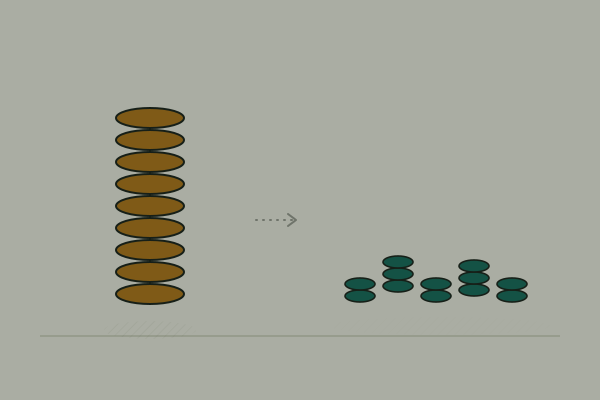
I’ve said “diversify” and “don’t put all your eggs in one basket” more than once on this blog without ever answering the actual practical question underneath it: how many stocks does it actually take before you’re meaningfully diversified? The honest answer surprises most people in both directions.
The one-sentence version
Diversification means spreading your money across enough different investments that no single one failing can seriously damage your total portfolio — and it works because different companies (and sectors, and countries) don’t all move together, so losses in one place tend to get offset by stability or gains somewhere else.
What diversification is actually doing, mechanically
Every individual stock carries two kinds of risk. Company-specific risk is the risk that’s unique to that one business — a bad product launch, a lawsuit, a scandal, a competitor eating its market share. Market risk is the risk that affects basically everything at once — a recession, rising interest rates, a broad market downturn.
Diversification can eliminate the first kind almost entirely and does nothing at all about the second. Owning 50 unrelated companies instead of 1 doesn’t protect you from a recession that drags the whole market down — it protects you from any one of those 50 companies having its own bad year sinking your entire portfolio with it.
So how many stocks does it actually take?
This is the part with a real, researched answer, and it’s more than most people guess: studies going back decades have generally found that somewhere in the range of 20-30 individual stocks, spread across different sectors, captures most of the diversification benefit available from picking individual stocks — beyond that point, adding more names keeps helping, but with rapidly diminishing returns.
The catch: this only works if the 20-30 stocks are actually spread across different, unrelated sectors. Twenty tech stocks isn’t diversification in any meaningful sense — as I put it in an earlier post, that’s “a concentrated bet on one sector wearing a diversified costume.” True diversification needs different industries, different company sizes, and ideally some exposure outside just one country’s economy.
Why “just buy an index fund” sidesteps the whole question
This is the actual reason broad index funds get recommended so heavily for beginners: a total-market index fund doesn’t hold 20-30 companies, it holds thousands, across every major sector, automatically — you get the diversification benefit maxed out in a single purchase, without having to research or track dozens of individual positions yourself. Picking 25 well-researched stocks across different sectors can get you most of the way to the same diversification benefit, but it takes real, ongoing effort to build and maintain correctly. An index fund gets you there by default.
What under-diversified actually looks like in practice
It’s not always “I only own one stock.” The more common versions:
- Owning several stocks that are all correlated — several bank stocks, or several tech stocks, that all tend to rise and fall together because they’re exposed to the same underlying risks.
- A portfolio dominated by employer stock — common when a large chunk of compensation comes as stock in the company you work for. Your paycheck and a big share of your investments are now both tied to the same employer’s fortunes, which is a specific, well-known concentration risk worth actively managing.
- A “diversified-looking” portfolio that’s secretly concentrated — five different funds that all happen to track the same or overlapping indexes isn’t five times the diversification, it’s mostly the same exposure five times over.
What diversification doesn’t do
It’s worth being honest about the limits. Diversification doesn’t protect against a broad market decline — a total-market index fund still drops when the whole market drops, just not as sharply as any single struggling company might. It doesn’t guarantee a positive return. And over-diversifying can quietly work against you too: past a certain point, adding more overlapping funds mostly adds complexity and fees without adding real additional protection.
The takeaway
“Diversify” isn’t a vague virtue, it’s a specific, researchable question with a real answer: roughly 20-30 well-spread individual stocks gets you most of the practical benefit, or a broad index fund gets you effectively all of it in one step. If you’re holding fewer than a handful of positions, or several positions that all rise and fall together, that’s the actual, checkable definition of “not diversified” — not a feeling, a number you can count.
Discussion