What Is Net Worth, and Why Should You Actually Track It?
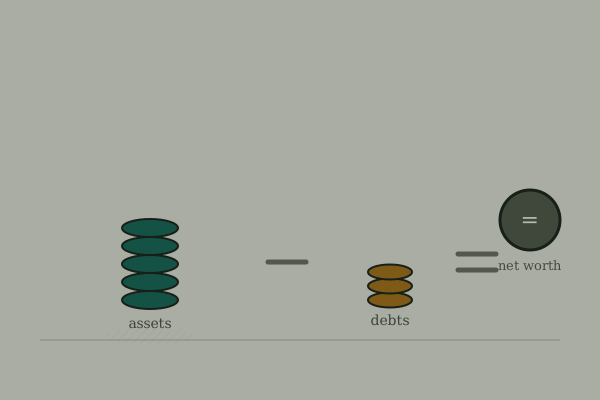
“Net worth” sounds like a number for people with yachts, which is exactly why most people never calculate their own — but it’s just a subtraction problem, and it’s the single most useful number for actually knowing whether your finances are headed in the right direction.
The one-sentence version
Net worth is everything you own (assets) minus everything you owe (debts/liabilities) — a single number that captures your entire financial position at once, regardless of whether it’s positive, negative, small, or large.
How to actually calculate it
Add up your assets — cash in checking and savings, your emergency fund, investment and retirement account balances, and (if you want to include it) the estimated value of things like a car or a house.
Add up your liabilities — credit card balances, student loans, a car loan, a mortgage, any other debt you owe.
Subtract. That’s it. A 24-year-old with $8,000 in savings and investments and $15,000 in student loans has a net worth of −$7,000. That’s not a crisis or a failure — it’s an honest, specific number, and specific numbers are useful precisely because you can watch them change.
Why a negative number isn’t the point
A negative net worth is extremely common early in adulthood — student loans, a car loan, or early-career low savings can all put the number below zero, and that’s a normal starting point, not a red flag by itself. The number itself, especially early on, matters far less than which direction it’s moving. Someone with −$10,000 net worth that improves by $5,000 a year is in a fundamentally healthier position than someone with +$20,000 net worth that’s been declining for three years, even though the second person’s raw number currently looks better.
Why this is more useful than tracking any single account
Checking your investment balance alone, or your credit card balance alone, gives you a fragment — it’s easy to feel good about a growing investment account while ignoring a credit card balance quietly climbing right alongside it. Net worth forces everything onto one line: growth in your index fund and a shrinking emergency fund and a creeping credit card balance all net out into one honest number, instead of three separate stories you can choose to look at selectively.
What actually moves the number, and by how much
Three things change your net worth, and they’re not equally controllable:
- Paying down debt moves the number dollar-for-dollar, guaranteed, the moment the payment posts — no market risk involved.
- Saving and investing new money moves it dollar-for-dollar going in, then continues moving with compounding and market performance from there.
- Market movement on existing investments moves the number up or down on its own, which is also why a single bad month shouldn’t be read as a verdict on your overall financial trajectory — it’s noise on top of the trend, not the trend itself.
How often to actually check it
Monthly or quarterly is plenty — this isn’t a number that benefits from daily attention, and checking it too often mostly just exposes you to short-term market noise in a way that can feel discouraging for no real reason. A spreadsheet with one row per month (assets, liabilities, net worth) takes a few minutes to update and turns an abstract feeling of “am I doing okay financially” into an actual trend line you can look at.
What not to do with it
Don’t compare your net worth to someone else’s without knowing their starting point, their age, their debt situation, or their income — the number is only genuinely useful compared against your own past numbers, which is the entire reason tracking it over time matters more than any single snapshot. And don’t let a temporarily negative number talk you out of also building an emergency fund or investing — those are usually still worth doing in parallel with paying down debt, not after net worth turns positive, which could take years.
The takeaway
Net worth isn’t a status symbol, it’s a diagnostic — assets minus debts, tracked over time, is the most honest single read on whether your overall finances are improving. Calculate it once to get a real starting point, however unglamorous the number, then check it again next month. The trend is the actual information; the first number is just where the trend starts.
Discussion