What Is Dollar-Cost Averaging? (And Why It Beats Trying to Time the Market)
“I’m waiting for the market to dip before I invest” is one of the most common reasons people give for not investing yet — and it sounds reasonable. Buy low, right? The problem is that nobody, including professional fund managers with entire research teams, can reliably predict when “low” actually is. Dollar-cost averaging is the strategy that sidesteps that problem entirely, by refusing to try.
The one-sentence version
Dollar-cost averaging (DCA) means investing a fixed amount of money at regular intervals — say, $200 on the 1st of every month — regardless of whether prices are up, down, or sideways that day, instead of trying to invest a lump sum at the “perfect” moment.
Why this works better than it sounds
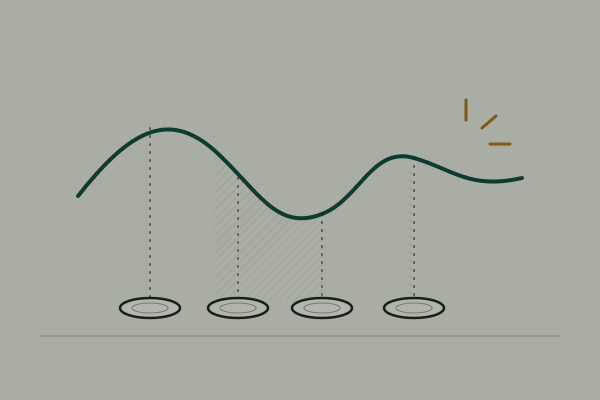
The mechanism is almost mechanical: when prices are high, your fixed $200 buys fewer shares. When prices are low, that same $200 buys more shares. Over time, this naturally averages your purchase price across the market’s ups and downs — you’re never all-in at the peak, and you’re never sitting in cash trying to guess the bottom.
Say you invest $200 a month for four months, and the price per share does this: $20, $25, $15, $20.
| Month | Price/share | Shares bought with $200 |
|---|---|---|
| 1 | $20 | 10.0 |
| 2 | $25 | 8.0 |
| 3 | $15 | 13.3 |
| 4 | $20 | 10.0 |
You spent $800 total and ended up with 41.3 shares — an average cost of about $19.37 per share, even though the price was $20 or higher in three of the four months. The dip in month 3 automatically bought you more shares for the same money, without you having to correctly predict that month 3 would be the low point.
What it’s actually solving
The real problem DCA solves isn’t a math problem — it’s a psychology problem. “Wait for a dip” sounds disciplined, but in practice it usually means one of two things happens: the market keeps rising and the person waiting never finds an entry point they’re comfortable with (so they simply never invest), or the market does dip, and the same fear that made them cautious in the first place makes them even more hesitant to buy during an actual downturn, when everything looks worse, not better. Dollar-cost averaging removes the decision entirely — the schedule decides, not your read on the market that week.
The honest counterpoint
If you already have a lump sum sitting in cash — an inheritance, a bonus, savings you’ve decided to invest — historical data generally shows that investing it all at once tends to outperform spreading it out via DCA, simply because markets rise more often than they fall over any long stretch, so money in the market sooner has more time to grow than money still waiting on the sidelines to be deployed gradually. DCA isn’t the mathematically optimal choice for a lump sum you already have; it’s the practically optimal choice for money you don’t have yet and are earning over time.
That distinction matters: if you’re investing out of a paycheck, you’re already dollar-cost averaging by default — you don’t have the option to invest five years of future salary today, so a recurring monthly contribution isn’t a strategy you’re choosing over lump-sum investing, it’s just what investing out of ongoing income looks like. DCA earns its name as a deliberate strategy mainly in the case where someone does have a lump sum and chooses to feed it in gradually anyway, usually to reduce the emotional risk of a bad-timing lump sum, at some cost to expected return.
What this doesn’t fix
Dollar-cost averaging doesn’t protect you from a bad investment — buying a fixed dollar amount of something that’s declining forever still loses money, just more slowly than a lump sum would have. It manages timing risk, not selection risk. That’s part of why DCA is most commonly recommended for broad index funds rather than individual stocks: the “will this specific company still exist and grow in ten years” question doesn’t go away just because you’re buying gradually instead of all at once.
The takeaway
You don’t need to time the market to invest well — you need a schedule and the discipline to keep it during the months prices look bad, which is exactly when dollar-cost averaging is quietly doing the most work. If you’re already investing a set amount from every paycheck, you’re not missing out on some better strategy called DCA. You’re already doing it.
Discussion