Marginal vs. Effective Tax Rate: Why a Raise Can't Shrink Your Paycheck
I’ve written about tax brackets in the Traditional vs. Roth IRA post and the capital gains post without ever explaining the single most misunderstood fact about them: a raise that pushes you into a higher tax bracket does not tax all of your income at that higher rate. This misconception has talked people out of raises, bonuses, and side income for no real reason, and the actual mechanism is simpler than the myth.
The one-sentence version
The U.S. income tax system is marginal, meaning each tax bracket only applies to the income earned within that specific bracket’s range — not to your entire income once you cross into a higher bracket.
The myth, stated plainly
“I turned down the raise because it would push me into the next tax bracket and I’d actually take home less money.” This is mathematically impossible under how marginal tax brackets work, and it’s one of the most common, costliest misunderstandings in personal finance — costly because it talks people out of raises, bonuses, and freelance income that would have left them with strictly more money, every time, with no exception.
How brackets actually work, with real structure
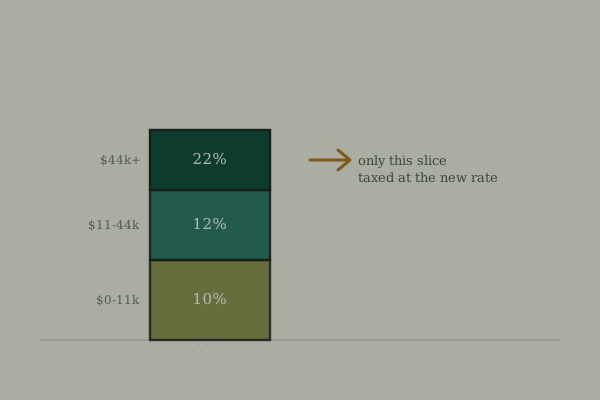
Tax brackets apply in layers, like filling a staircase from the bottom up. Using simplified, illustrative brackets (actual rates and thresholds change by year and are not the point here):
| Income range | Rate on income in that range |
|---|---|
| $0 – $11,000 | 10% |
| $11,000 – $44,000 | 12% |
| $44,000 – $95,000 | 22% |
Someone earning $50,000 does not pay 22% on all $50,000. They pay 10% on the first $11,000, 12% on the next $33,000 (up to $44,000), and 22% only on the remaining $6,000 above $44,000. Each dollar is taxed according to which layer it falls into — crossing into the 22% bracket only exposes the dollars above $44,000 to that rate, never the dollars already taxed at 10% or 12%.
Why a raise can never reduce your take-home pay
Follow the mechanism through: if that same person gets a $5,000 raise to $55,000, only the new $5,000 gets taxed at 22% (since it’s entirely above the $44,000 threshold) — every dollar they were already earning keeps being taxed exactly the same way it was before. The raise adds $5,000 pre-tax, loses $1,100 to tax on that specific slice, and nets $3,900 more take-home pay. More money, always — a marginal system has no mechanism that can make additional income shrink your take-home pay, because no bracket ever reaches backward and re-taxes money that was already in a lower one.
Marginal rate vs. effective rate — two different numbers
Marginal rate is the rate on your next dollar of income — the rate that applies to the top slice of what you earn, and the number people usually mean when they say “I’m in the 22% bracket.”
Effective rate is your actual overall rate — total tax paid divided by total income. In the $50,000 example above, the person is “in” the 22% bracket, but their effective rate is meaningfully lower, because most of their income was taxed at 10% and 12%, not 22%. The effective rate is always lower than or equal to the marginal rate for anyone with income spanning more than one bracket, which is almost everyone.
This distinction is exactly why the Traditional vs. Roth IRA comparison talks about “your tax bracket now vs. in retirement” using the marginal rate specifically — a Traditional IRA contribution is deducted off the top of your income, meaning it saves you tax at your marginal rate, the rate on the dollars you’re not earning anymore because they went into the account instead.
Why this misconception is so sticky
“I’m in the 22% bracket” sounds like a flat statement about your whole income, and most casual conversation about tax brackets talks about them that way, which is exactly backward from how the math actually works. The confusion isn’t irrational — it’s a reasonable reading of imprecise language, just one that happens to be wrong in a way that occasionally costs people real money when it changes an actual decision (turning down extra work, timing a bonus, structuring freelance income) based on a calculation that was never actually true.
The takeaway
Every dollar you earn is taxed based on which bracket layer it falls into, not your highest bracket applied retroactively to everything below it — which means more income is always, unconditionally, better for your take-home pay under this system. If a specific tax decision ever seems to hinge on “staying out of the next bracket,” that reasoning is worth double-checking against the actual marginal mechanism before it changes anything real.
Discussion