Traditional vs. Roth IRA: Which One Should You Actually Use?
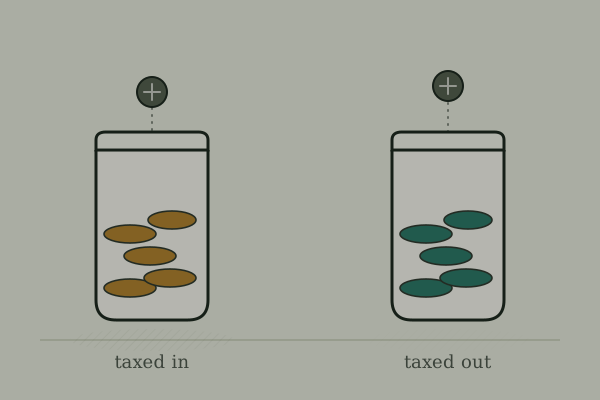
I wrote about what a Roth IRA is and mentioned its main alternative, a Traditional IRA, in one paragraph near the bottom without actually doing the math on how they compare. That undersells it — this is a real decision with a real answer, and the answer isn’t “Roth, obviously,” even though that’s the framing most beginner content defaults to.
The one-sentence version
Both let your investments grow tax-deferred or tax-free for retirement — a Traditional IRA taxes the money on the way out, a Roth IRA taxes it on the way in, and which one leaves you with more depends entirely on whether your tax rate is higher now or in retirement.
The mechanical difference
Traditional IRA: you contribute pre-tax money (it reduces your taxable income this year), it grows tax-deferred, and you pay ordinary income tax on withdrawals in retirement.
Roth IRA: you contribute money you’ve already paid tax on, it grows completely tax-free, and you owe nothing on withdrawals in retirement.
Same investments, same growth, same account rules in most other respects (contribution limits, early-withdrawal restrictions on growth). The entire difference is when the IRS gets paid — now or later.
The math that actually decides it
Here’s $6,500 contributed once, grown at 7% for 30 years, compared at three different combinations of “tax bracket now” vs. “tax bracket at withdrawal”:
| Tax bracket now → at withdrawal | Roth (after-tax result) | Traditional (after-tax result) |
|---|---|---|
| 22% → 22% (same both times) | $38,594 | $38,594 |
| 12% → 22% (lower now, higher later) | $43,542 | $38,594 |
| 24% → 12% (higher now, lower later) | $37,605 | $43,542 |
Three things worth sitting with in that table:
When the tax rate is identical both times, the two accounts produce the exact same result. This surprises people — it feels like Roth “must” be better because you never see a tax bill on withdrawal, but mathematically, paying a tax rate on the smaller number now (your contribution) or the same rate on the larger number later (your contribution grown 7%/year for 30 years) works out identically, because tax is a percentage either way.
A Roth wins when your rate is lower now than it will be later. This is the classic case for someone early in their career — you’re likely in a lower bracket now than you’ll be at your peak earning years, so paying tax at today’s lower rate is the better trade.
A Traditional IRA wins when your rate is higher now than it will be later. This is the classic case for someone at peak earnings, expecting a lower-spending, lower-bracket retirement — deferring tax off a high-rate year onto a future lower-rate year is the better trade, and it also lowers your taxable income this year, which can matter beyond just the IRA itself.
Why the “Roth is always better” advice exists anyway
It’s not wrong for the audience it’s usually aimed at. Most personal finance content assuming a young, early-career reader is implicitly assuming the “lower now, higher later” case — and for that specific situation, Roth really is the better bet. The advice becomes actively wrong once you’re further into your career, in a high bracket, and expecting a more modest retirement income — at that point the Traditional IRA’s tax break is doing real work.
What nobody can actually know for certain
The honest complication: nobody knows their future tax bracket with certainty. It depends on future income (yours), and on future tax law (the government’s), and both can genuinely change over 20-30 years. This isn’t a reason to freeze up over the decision — it’s a reason to treat “which bracket am I probably in now vs. later” as a reasonable best guess, not a precise calculation, and to not be surprised if the honest answer for you is “close enough that either is fine.”
The practical middle ground
You don’t actually have to pick exactly one forever. Some people split contributions between both account types specifically to hedge against not knowing future tax rates — you can even find yourself contributing to a Traditional IRA in a high-income year and a Roth IRA in a lower-income year, since the better trade genuinely changes year to year with your actual bracket. Employer 401(k) plans increasingly offer both a Traditional and Roth option for exactly this reason.
The takeaway
There’s no universally correct answer between a Traditional and Roth IRA — there’s only “which tax rate do you expect to be higher, now or in retirement,” and the honest version of that question doesn’t have a certain answer for anyone. What is certain: if you’re early-career and in a meaningfully lower bracket than you expect to be later, the math favors Roth, which is exactly the situation most of the “just do Roth” advice online is quietly assuming about its reader — worth checking whether that assumption actually applies to you before taking the advice at face value.
Discussion