What Is a Target-Date Fund? Should You Just Use the Default Option?
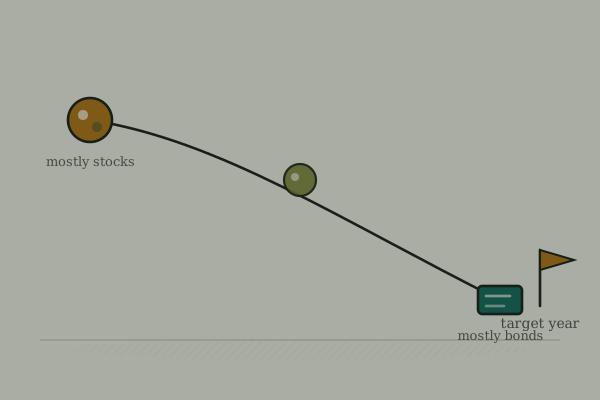
I mentioned target-date funds yesterday as the hands-off way to implement an age-based stock-to-bond mix, without actually explaining what one is. If you’ve ever opened a 401(k) and seen a fund named something like “Target 2060” sitting there as the default option, this is what that actually does.
The one-sentence version
A target-date fund is a single fund that automatically shifts from a stock-heavy mix toward a bond-heavy mix as a specific target year (usually your expected retirement year) approaches, so you never have to manually rebalance your own stock-vs-bond allocation as you get older.
How the mechanism actually works
Pick a target-date fund named for roughly the year you expect to retire — “Target 2060” if you’re planning to retire around 2060. Inside that one fund, the manager does three things on an ongoing basis:
- Holds a mix of stock and bond index funds (sometimes other assets too), weighted heavily toward stocks when the target date is decades away.
- Gradually shifts that mix toward bonds as the target date approaches — this is called the fund’s “glide path,” and it happens automatically, inside the fund, without you doing anything.
- Continues adjusting for a while after the target date, usually settling into a conservative, mostly-bond allocation meant to last through retirement itself, not just up to the day you retire.
You buy one fund, contribute to it regularly, and the stock-to-bond math from the age-based allocation post happens inside the fund automatically — no manual rebalancing, no deciding when to shift the mix yourself.
Why this is the default in most 401(k)s
Target-date funds solve a real problem: most people don’t rebalance their own portfolios on any consistent schedule, and a portfolio that’s drifted to 90% stocks at age 60 because nobody rebalanced it is a genuinely common, genuinely risky outcome. Making a target-date fund the default option for anyone who doesn’t actively choose something else is a deliberate design decision — it assumes correctly that a reasonable, automatically-adjusting default beats a portfolio nobody is managing.
The honest tradeoffs
You give up control over the exact glide path. Different fund providers shift their mix at different speeds and land on different final allocations — one company’s “Target 2060” fund might be meaningfully more aggressive or more conservative than another’s, even with the identical target year. This is worth actually checking rather than assuming all target-date funds with the same year behave identically.
The expense ratio matters more here than it sounds like it should, because a target-date fund is a fund of funds — some providers charge a competitive, low fee for the convenience; others charge noticeably more than the cost of just holding the underlying index funds separately. It’s worth checking this number specifically rather than assuming “it’s a retirement fund, the fee must be reasonable.”
It’s a one-size-fits-all glide path, not a personal one. Two people retiring the same year with very different risk tolerances, other income sources, or savings levels get the identical stock-to-bond shift inside the same target-date fund — it doesn’t know anything about your specific situation beyond the year you picked.
You can’t (easily) hold it alongside a lot of other manual positions and expect the “set it and forget it” benefit to hold — if you’re also picking individual stocks in the same account, you’ve reintroduced the manual-management problem the fund was supposed to solve.
The DIY alternative, briefly
The other common approach is a simple two-fund combination — a total-market stock index fund and a total-bond-market index fund, held at a chosen percentage you set and periodically rebalance yourself. This usually costs less in fees and gives you full control over the exact mix and glide speed, at the cost of actually having to check in and rebalance it periodically, which a target-date fund does for you automatically. Neither approach is objectively correct — it’s actively-managed convenience versus lower-cost, hands-on control.
When the default option is genuinely the right call
If you don’t want to think about rebalancing, don’t have strong opinions about the exact glide path, and the available target-date fund’s expense ratio is reasonable (check it against the underlying index funds’ own fees), using the default target-date fund in a 401(k) is a legitimately good choice, not a lazy one. It’s specifically designed to replace a decision most people weren’t going to make consistently anyway.
The takeaway
A target-date fund isn’t a mysterious black box — it’s the same age-based stock-to-bond logic from yesterday’s post, running automatically inside a single fund instead of something you’d manage by hand. Check its expense ratio before assuming it’s the cheap, obvious choice, and know that “Target 2060” at two different providers can mean two different actual allocations — but as a genuine default for someone who isn’t going to rebalance a DIY portfolio on schedule, it’s doing exactly the job it was built for.
Discussion