How Much Should Be in Stocks vs. Bonds? Age-Based Allocation, Explained
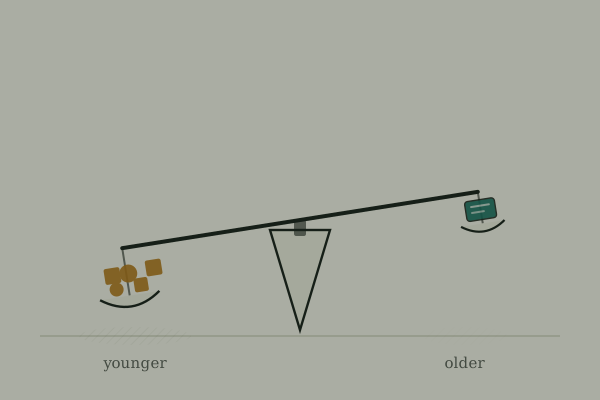
I’ve explained what a stock is, what a bond is, and how much diversification actually takes — but never the question that actually gets typed into a search bar: what percentage of each should I own, right now, at my age? There’s a real rule of thumb here, and real reasons it’s just a starting point.
The one-sentence version
The classic rule of thumb is to hold roughly “(110 or 120 minus your age)” percent in stocks and the rest in bonds — younger investors lean heavily toward stocks for their higher long-term growth, and the stock percentage gradually shifts toward bonds as retirement gets closer and there’s less time to recover from a bad year.
Why age changes the math at all
Stocks have historically outperformed bonds over long periods, but with much bigger swings year to year. Bonds are more stable but grow more slowly. The right mix isn’t about which one is “better” — it’s about how much time you have before you need the money, which is really a question about how much time you’d have to recover from a bad year if one hit right before you needed to withdraw.
A 25-year-old’s retirement money has 40 years to ride out a bad decade. A 63-year-old’s retirement money, about to be withdrawn, doesn’t have that luxury — a 30% drop the year before retirement is a very different problem at 63 than it is at 25, even though it’s the identical percentage drop.
The rule of thumb, with real numbers
Take 110 (a commonly used version; some use 100, some 120) and subtract your age. That’s roughly your stock percentage; the rest goes to bonds.
| Age | Stock % (110 − age) | Bond % |
|---|---|---|
| 25 | 85% | 15% |
| 35 | 75% | 25% |
| 45 | 65% | 35% |
| 55 | 55% | 45% |
| 65 | 45% | 55% |
The shape matters more than the exact numbers: heavily stock-weighted early, gradually sliding toward bonds, never fully abandoning stocks even in retirement (since a 65-year-old might still have 20-30 years of retirement ahead, which is still a long investing horizon for part of the portfolio).
Why this is a starting point, not a formula
The rule of thumb assumes a fairly generic situation, and real circumstances routinely justify deviating from it:
Risk tolerance isn’t just a number — it’s whether you can actually sit through a drop without panic-selling. As I covered in investing lessons learned late, the single most damaging investing behavior is selling at the bottom. If a 50% stock allocation genuinely keeps you up at night to the point you’d sell during a downturn, a more conservative mix you can actually stick with beats a “correct” one you’ll abandon at the worst moment.
Other income sources change the math. Someone with a pension or a very stable, secure income has a built-in bond-like cushion already, which can justify leaning more heavily into stocks than the formula suggests, even later in life.
This applies per goal, not to your whole net worth at once. Retirement money 30 years out and a house down payment fund needed in 3 years shouldn’t use the same allocation just because they belong to the same person — the house fund should look far more conservative, closer to the savings end of the savings-vs-investing spectrum, regardless of your age.
How this actually gets implemented
You don’t need to hand-pick individual bonds and stocks to hit a target percentage — this is largely what target-date funds are built to do automatically: pick one roughly matching your expected retirement year, and the fund gradually shifts its own stock-to-bond mix over time on your behalf, without you rebalancing anything yourself. Alternatively, a simple two-fund combination — a total-market stock index fund and a total-bond-market index fund, held at your chosen percentages — gets you the same result with slightly more hands-on control (you’d need to periodically rebalance back to your target as the two grow at different rates).
The takeaway
“110 minus your age” isn’t a precise formula, it’s a reasonable default that encodes a real principle: more time to recover justifies more stock exposure, and that justification shrinks as the time horizon does. Use it as a starting point, adjust it for your actual risk tolerance and specific goals, and don’t mistake “the math says 70% stocks” for a reason to hold an allocation that would make you panic-sell the next time the market drops 20%.
Discussion