W-2 vs. 1099: What Actually Changes When You're Not a Full-Time Employee
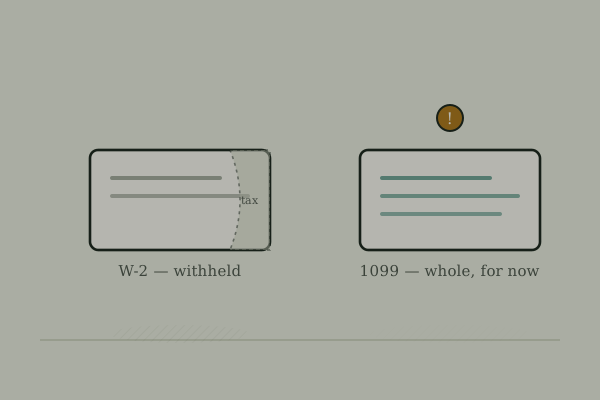
I wrote about what to do with your first paycheck assuming a standard W-2 job, which quietly left out a growing share of how people actually earn money — gig work, freelancing, contract jobs. If you’ve gotten a 1099 instead of a W-2, the tax mechanics change more than people expect, and the surprise usually shows up at tax time, which is exactly the wrong time to learn about it.
The one-sentence version
A W-2 employee has taxes automatically withheld from every paycheck and gets certain benefits; a 1099 contractor receives their full pay with nothing withheld, owes self-employment tax on top of regular income tax, and is responsible for setting aside and paying that tax themselves.
What each form actually means
W-2 means you’re a traditional employee. Your employer withholds income tax, Social Security, and Medicare from every paycheck automatically, often offers benefits (health insurance, a 401(k) match), and pays half of your Social Security and Medicare taxes on your behalf.
1099 means you’re an independent contractor, not an employee — gig driving, freelance work, consulting, contract projects. You receive your full agreed-upon pay with nothing withheld, get no employer-provided benefits, and are personally responsible for both your own income tax and the full Social Security/Medicare tax that a W-2 employer would normally split with you.
The tax difference that actually surprises people
This is the part that catches first-time contractors off guard: self-employment tax. A W-2 employee pays 7.65% of their wages toward Social Security and Medicare, with their employer matching that other 7.65% — 15.3% total, split evenly. A 1099 contractor has no employer to split it with, so they owe the full 15.3% themselves, on top of regular income tax on the same earnings.
Here’s $50,000 in gross earnings, compared:
| W-2 employee | 1099 contractor | |
|---|---|---|
| Social Security + Medicare | 7.65% ($3,825), employer pays the other half | 15.3% ($7,650), all on you |
| Income tax withheld automatically? | Yes, every paycheck | No — nothing withheld by default |
The $50,000 1099 earner doesn’t actually take home more than an equivalent W-2 salary just because nothing was withheld upfront — the tax is still owed, just not collected automatically, which is exactly the trap: spending the full amount as it arrives, then owing a large lump sum (self-employment tax plus income tax) the following tax season with nothing set aside to cover it.
Why “nothing was withheld” doesn’t mean “I owe nothing”
This is the single most important practical takeaway: a 1099 payment showing up in full, with no taxes removed, is not the same as tax-free income. It means the withholding step a W-2 job handles automatically simply didn’t happen — the tax liability is identical in kind, just not yet collected. Treating a 1099 paycheck as fully spendable is the single most common mistake that turns into a painful tax bill.
The practical fix: set aside a percentage, every time
A reasonable starting rule of thumb: set aside 25-30% of every 1099 payment into a separate high-yield savings account the moment it arrives, before spending any of it. That range covers self-employment tax plus a reasonable estimate of income tax for most moderate earners — it won’t be exact, but it’s a far safer default than discovering the real number in April with nothing saved.
Quarterly estimated taxes are also a real requirement for most 1099 earners with a meaningful tax liability, not an optional convenience — the IRS expects tax payments spread through the year (April, June, September, January), not one lump sum at filing time, and underpaying throughout the year can trigger a penalty even if the full amount gets paid eventually.
What 1099 work gets to deduct that W-2 work doesn’t
The one real upside worth knowing: 1099 income is reported on a Schedule C, which allows deducting legitimate business expenses before calculating what’s actually owed — a home office, equipment, mileage, software subscriptions used for the work, and similar costs reduce the taxable amount. A W-2 employee generally can’t deduct equivalent job expenses the same way. This doesn’t offset the self-employment tax gap entirely, but it’s a real, often underused piece of the picture worth tracking expenses for throughout the year, not scrambling to reconstruct at tax time.
What doesn’t change
Whether you’re a W-2 employee or a 1099 contractor, the rest of this blog’s advice still applies identically once the money is actually yours: an emergency fund, investing in a brokerage account or IRA, and the 50/30/20 budget framework all still work — the only real difference is that a 1099 earner needs to do the tax-setting-aside step manually that a W-2 job does invisibly.
The takeaway
A 1099 isn’t a worse paycheck, it’s an unwithheld one — the money you see is the full amount, not the take-home amount, and the gap between those two numbers (self-employment tax plus income tax) is real whether or not anyone reminds you of it. Set aside 25-30% the moment it lands, track deductible expenses as you go, and the tax-season surprise that catches so many first-time contractors simply doesn’t happen to you.
Discussion