What Is a Brokerage Account, Actually? The Account Everything Else Assumes You Have
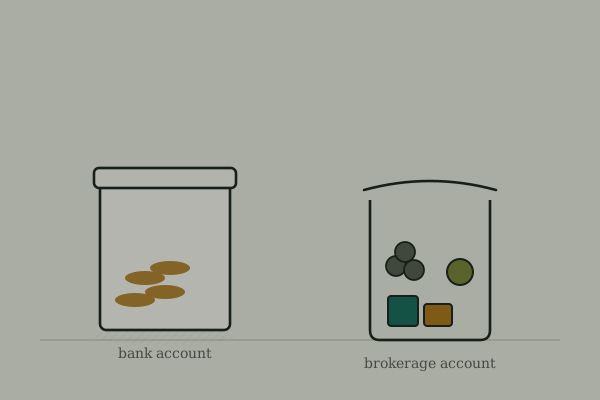
I’ve used the phrase “brokerage account” in nearly every post on this blog — “a regular brokerage account,” “your Robinhood brokerage account,” “a taxable brokerage account” — without ever stopping to explain what one actually is. If you’ve opened one but never quite had it explained plainly, or you’re still picturing it as “a fancier bank account,” here’s the actual answer.
The one-sentence version
A brokerage account is an account that lets you buy and hold investments — stocks, bonds, index funds — which a bank account, built only to hold cash, simply isn’t designed to do.
How it’s actually different from a bank account
A bank account holds cash and pays (if anything) a small amount of interest on it. A brokerage account holds cash too, but its real purpose is letting you convert that cash into investments and back — buying shares, selling them, and holding whatever you own in between. The brokerage itself (Robinhood, Fidelity, Schwab, Vanguard, and others) is the company that executes those trades and holds your investments on your behalf, similar in spirit to how a bank holds your cash, but for a fundamentally different kind of asset.
Money in a brokerage account isn’t automatically invested just by being there — depositing cash into the account and actually buying something with it are two separate steps. A brokerage account sitting in cash, uninvested, isn’t doing anything differently from a checking account, just without FDIC coverage on the cash portion in the same way (brokerages typically offer SIPC protection instead, which covers the loss of securities and cash in your account if the brokerage itself fails — a different protection than FDIC, covering a different kind of risk).
What “taxable” and “regular” actually mean here
When I’ve written “regular brokerage account” or “taxable brokerage account” in other posts, I mean specifically: a brokerage account with no special tax treatment, as opposed to a Roth or Traditional IRA, which are brokerage accounts too, just wrapped in a specific tax rule. Every brokerage account holds investments the same basic way — buy, hold, sell — but a regular one has no contribution limits, no income restrictions, and no early-withdrawal penalties, in exchange for normal capital gains tax on your gains and dividends along the way. An IRA is a brokerage account with a tax deal attached; a “regular” brokerage account is the same basic tool with no deal attached.
What you can actually hold in one
Individual stocks, bonds, ETFs and mutual funds, and (depending on the brokerage and your account approval level) options. It’s a single account that can hold many different kinds of investments at once — you’re not limited to one type, and most people’s accounts end up holding a mix.
Opening one, practically
There’s no meaningful barrier beyond providing identity information the brokerage is legally required to collect (Social Security number, address, employment info) — most major brokerages have no minimum deposit to open an account, and many support fractional shares, so you can start with whatever amount you actually have rather than needing enough for a full share of an expensive stock.
The parts that confuse people early on
Cash sitting in the account earns little or nothing by default, unlike the whole point of a high-yield savings account — some brokerages auto-sweep uninvested cash into a money-market fund paying a reasonable rate, others don’t, so it’s worth checking rather than assuming.
A sale doesn’t settle instantly in terms of using the proceeds. Selling a stock typically takes a day or two to “settle” before the cash is freely available to withdraw or reinvest without restriction, even though the sale itself executes immediately — a detail that occasionally surprises a first-time seller expecting cash the same second a trade executes.
It’s one account type, used for very different purposes. The same brokerage account structure holds a 25-year-old’s first $50 index fund purchase and a retiree’s seven-figure portfolio — the account itself doesn’t change with the amount or the strategy; only what’s inside it does.
The takeaway
A brokerage account is the plain, un-glamorous infrastructure underneath almost everything else this blog talks about — not a special account for “serious investors,” just the account type that lets cash become an investment and back again. Once that’s clear, terms like “taxable account,” “regular brokerage,” and the contrast with an IRA stop being jargon and start being exactly what they sound like: the same basic tool, with or without a tax wrapper attached.
Discussion